

Product Description:
is pleased to offer our clients the following.
This lightweight titanium wheel lug nut kit is designed for racing wheels that use an M14×1.5 threaded stud and a shank-style lug arrangement.
Developed for racers looking to remove weight from rotating and unsprung components, the complete ten-lug kit weighs approximately 7 ounces. Hawks compares this with approximately 1 pound 5 ounces for a standard set of ten Weld-style shank lug nuts, representing a weight reduction of approximately 14 ounces per ten-lug set.
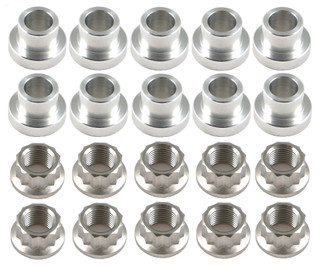
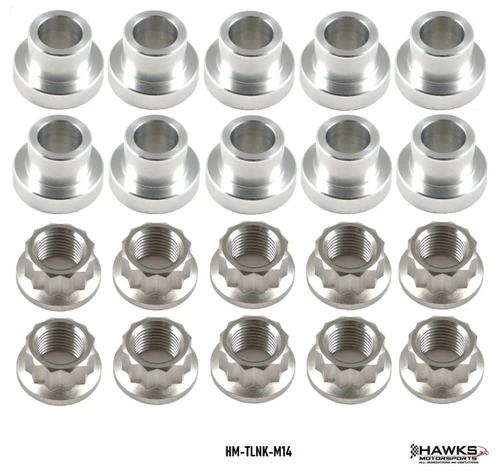
Each kit contains ten titanium 12-point lug nuts and ten aluminum shank-style spacers.

Key Features
| Feature | Product specification |
|---|---|
| Producer | Hawks Motorsports |
| Product type | Lightweight racing wheel lug nut kit |
| Thread size | M14×1.5 |
| Lug-nut material | Titanium |
| Lug-nut head | 12-point |
| Wheel-seat design | Shank style |
| Spacer material | Aluminum |
| Lug-nut quantity | 10 |
| Spacer quantity | 10 |
| Complete kit weight | Approximately 7 ounces |
| Intended application | Compatible shank-style racing wheels |
| Condition | New |

This Product Includes
- Ten M14×1.5 titanium lug nuts
- Ten aluminum shank-style spacers
- Twelve-point lug-nut head design
- Components for two conventional five-lug wheels
This ten-piece lug-nut kit is not a complete set for all four wheels on a conventional five-lug vehicle. Four kits are required when twenty lug positions use this configuration.
Lightweight Titanium Construction
Removing weight is particularly important in drag-racing applications where racers evaluate every component for potential mass reduction.
According to the Hawks Motorsports comparison:
| Ten-lug configuration | Approximate weight |
|---|---|
| Hawks titanium lug kit | 7 ounces |
| Standard Weld-style shank lug nuts | 1 pound 5 ounces |
| Approximate reduction | 14 ounces |
The stated comparison represents approximately a 67-percent reduction in lug-nut kit weight.
Actual weight differences can vary when compared with other manufacturers, designs, shank lengths, washers or materials.
Shank-Style Wheel Design
Shank-style lug nuts differ from conventional conical-seat or ball-seat lug nuts.
In a shank-style arrangement, the cylindrical portion extends into the wheel’s lug opening. The compatible spacer or washer provides the required clamping surface against the wheel.
This design is commonly found on purpose-built drag and racing wheels, including compatible wheels from manufacturers such as Weld Racing. Brand alone does not establish compatibility because individual wheel models can use different lug-seat designs and dimensions.
Wheel / Stud Interchange
| Required feature | Compatible specification |
|---|---|
| Wheel-stud thread | M14×1.5 |
| Wheel lug-seat design | Shank style |
| Lug opening | Must accept the supplied shank spacer |
| Wheel surface | Must provide the correct flat clamping surface |
| Tool interface | Correct 12-point socket |
| Stud engagement | Must meet wheel and stud manufacturer requirements |
| Vehicle application | Determined by stud and wheel specifications |
These lug nuts are not selected by vehicle year and model alone. Wheel-stud thread, wheel-seat design, lug-hole diameter, wheel thickness, shank dimensions and thread engagement must all be verified.

Important Application Notes
- Fits M14×1.5 wheel studs only
- Designed for compatible shank-style racing wheels
- Does not replace a 60-degree conical-seat lug nut
- Does not replace a ball-seat or radius-seat lug nut
- Do not use on M12×1.5, M12×1.25, 1/2-20 or other thread sizes
- Kit contains ten lug nuts and ten aluminum spacers
- One kit services two conventional five-lug wheels
- Four kits are required for twenty lug positions
- Shank diameter and effective length must match the wheel
- Stud engagement must be confirmed before operation
- Follow the wheel, stud and vehicle manufacturer’s torque requirements
“Universal” shank-style compatibility should not be assumed. The wheel manufacturer’s specifications control the required lug design.
M14×1.5 Thread Application
The M14×1.5 designation identifies:
- A nominal 14-millimeter wheel-stud diameter
- A 1.5-millimeter distance between thread peaks
A lug nut with the wrong diameter or thread pitch can damage the stud and may not safely retain the wheel.
Before ordering, verify the vehicle’s actual wheel studs rather than relying solely on a general vehicle application guide. Modified vehicles may use aftermarket axles, hubs or studs that differ from the original configuration.
Twelve-Point Head
The titanium lug nuts use a 12-point head. Installation and removal require a correctly sized 12-point socket that fully engages the lug nut.
Do not use:
- An incorrectly sized socket
- A six-point socket
- Worn or rounded tools
- Pliers or adjustable wrenches
- A socket that contacts only part of the lug nut
Improper tool engagement can damage the lug nut’s drive surfaces.
Aluminum Shank-Style Spacers
Ten aluminum shank-style spacers are supplied with the lug nuts. These components are part of the intended wheel-clamping arrangement and should be installed in the correct orientation.
Inspect each spacer before installation. Do not use a spacer that is cracked, distorted, deeply gouged or otherwise damaged.
The supplied spacer must sit correctly against the wheel and must not bottom against the hub, rotor, stud shoulder or another component before the wheel is properly clamped.
Racing-Wheel Compatibility
These lug nuts may fit many drag wheels that use the appropriate shank-style arrangement, but compatibility must be established by measurements and wheel-manufacturer specifications.
Before use, confirm:
- M14×1.5 stud thread
- Lug-hole diameter
- Wheel thickness at the lug opening
- Required shank diameter
- Required shank length
- Spacer contact area
- Available thread engagement
- Socket clearance
- Recommended torque
- Wheel-manufacturer approval for the lug design
A shank that is too large will not enter the wheel opening. A shank that is too long may bottom out before achieving proper clamping force. A shank that is too short may not provide the intended wheel location or support.
Installation Information
Wheel installation is safety-critical. Installation should be completed by a qualified technician familiar with racing wheels and shank-style lug systems.
Before installation:
- Verify that every wheel stud is M14×1.5
- Inspect the studs for damaged or contaminated threads
- Confirm that the wheel uses a shank-style lug system
- Compare the supplied components with the wheel specifications
- Make sure each spacer sits flat against the wheel
- Start every lug nut by hand
- Confirm smooth thread engagement
- Tighten the lug nuts gradually in the proper crossing sequence
- Use a calibrated torque wrench
- Follow the wheel, stud and vehicle manufacturer’s torque specification
- Verify that the lug nuts do not bottom on the studs
- Confirm that the wheel is fully seated against the hub
- Check brake, suspension and socket clearance
- Recheck torque according to the wheel manufacturer’s instructions
Do not lubricate the threads unless the wheel-stud or lug-nut manufacturer specifically provides a lubricated torque specification. Lubrication changes the relationship between applied torque and clamping force.
Titanium and aluminum components should be kept clean. Contamination, damaged threads or galling can interfere with accurate tightening.
Inspection and Maintenance
Racing wheel fasteners should be inspected regularly.
Check for:
- Damaged or distorted threads
- Galling or material transfer
- Rounded 12-point drive surfaces
- Cracked or deformed spacers
- Uneven wheel-seat contact
- Loss of torque
- Impact damage
- Heat discoloration
- Wheel lug-hole damage
Remove any questionable component from service. Never continue using a lug nut or spacer that cannot be threaded, seated or torqued correctly.
PART NUMBER
HM-TLNK-M14

FREQUENTLY ASKED QUESTIONS
How many lug nuts are included?
The kit contains ten titanium lug nuts.
Are the shank-style spacers included?
Yes. Ten aluminum shank-style spacers are supplied.
What is the thread size?
The lug nuts use an M14×1.5 thread.
What material are the lug nuts made from?
The lug nuts are manufactured from titanium.
What material are the spacers made from?
The shank-style spacers are aluminum.
What type of socket is required?
The lug nuts have a 12-point head and require the correct-size 12-point socket.
How much does the kit weigh?
The complete ten-lug kit weighs approximately 7 ounces according to Hawks Motorsports.
How much lighter is it than standard Weld-style shank lug nuts?
Hawks compares the 7-ounce titanium kit with a standard ten-lug set weighing approximately 1 pound 5 ounces. That is an approximate reduction of 14 ounces.
Is this a complete four-wheel set?
No. A conventional five-lug vehicle uses twenty lug nuts. This kit contains ten, enough for two five-lug wheels.
How many kits are needed for two five-lug rear wheels?
One kit supplies the ten lug nuts required for two five-lug wheels.
How many kits are needed for all four five-lug wheels?
Four wheels require twenty lug nuts, so two ten-lug kits are needed—not four.
Will these fit any M14×1.5 vehicle?
Not automatically. The vehicle must have M14×1.5 studs, and the wheels must use a compatible shank-style lug arrangement.
Will these fit factory wheels?
Fitment should not be assumed. Most factory wheels use a specific conical, ball or captured-washer seat rather than this racing-style shank arrangement.
Will these fit Weld Racing wheels?
They may fit compatible Weld wheels designed for an M14×1.5 shank-style lug system. Verify the exact wheel model, lug-hole diameter, wheel thickness and required shank dimensions.
Are these conical-seat lug nuts?
No. They are designed for a shank-style wheel application.
Can they replace M12×1.5 lug nuts?
No. M12×1.5 and M14×1.5 threads are different.
Can they replace 1/2-20 lug nuts?
No. The 1/2-20 version is a separate thread size and product.
What torque specification should be used?
Follow the specifications supplied by the wheel, wheel-stud and vehicle manufacturers. Do not use a generic torque value without verifying the complete installation.
Can they be installed with an impact wrench?
Final tightening should be performed with a calibrated torque wrench. Impact tools can damage the components or produce uncontrolled clamping force.
Are these intended for racing use?
Yes. They are designed primarily for compatible drag and racing wheels using a shank-style lug system.
Qty: (10) M14x1.5 12-Point Titanium Lug Nuts
Qty: (10) Shank Style Aluminum Spacers