

Product Description:

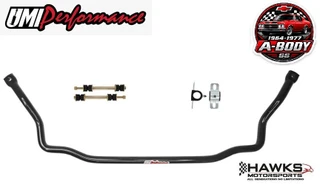
Hawks Motorsports is proud to offer our clients this : Bright Red 1964-1977 GM A-Body 1-5/16-Inch Solid Front Sway Bar from UMI Performance.
UMI Performance 4067 is an extra-heavy-duty front sway bar engineered for high-performance Chevrolet, Pontiac, Oldsmobile, Buick, and GMC A-body vehicles. It is designed to substantially reduce front-end body roll and provide flatter, more controlled cornering during aggressive street driving, Pro-Touring events, autocross competition, and road-course use.
Measuring 1-5/16 inches, or approximately 33.3mm, in diameter, #4067 is the larger and more aggressive alternative to UMI’s popular 1-1/4-inch #4035 front sway bar. Its increased diameter and solid construction provide additional roll resistance for high-performance vehicles equipped with modern suspension components, high-grip tires, and increased cornering capability.
Each sway bar is manufactured from solid 4140 chromoly steel and CNC-bent to maintain consistent geometry and proper alignment with the vehicle’s factory-style front sway-bar mounting locations. The fixed-rate, non-adjustable design provides predictable performance without requiring trackside adjustments.
The standard #4067 package includes polyurethane frame bushings with steel clamshell-style clamps and polyurethane end-link assemblies. UMI #2649 swivel-style end links are compatible and available separately for more competition-oriented installations.
UMI also offers its #90066 billet-aluminum front sway-bar mounts separately. These optional mounts are specifically sized for 1-5/16-inch sway bars and replace the standard steel frame clamps with precision-machined billet-aluminum mounts and greaseable polyurethane bushings.
UMI #4067 is offered in bright-red powder coat for lasting protection against corrosion and road exposure. The bar is manufactured, tested, and raced in the USA and has been used on UMI’s 1972 Pontiac LeMans test car at Goodguys, Optima, and LS Fest events.
This is an aggressive performance sway bar. Overall suspension balance will depend on the vehicle’s springs, shocks, tires, alignment, rear sway bar, ride height, and intended use.
4. KEY FEATURES
- Designed for applicable 1964-1977 GM A-body vehicles
- Extra-heavy-duty performance front sway bar
- 1-5/16-inch diameter
- Approximately 33.3mm diameter
- Larger and more aggressive than UMI’s 1-1/4-inch #4035 bar
- Solid one-piece construction
- Fixed-rate, non-adjustable design
- Helps substantially reduce front-end body roll
- Promotes flatter and more controlled cornering
- Improves steering response during rapid directional changes
- Designed for high-performance vehicles with modern high-grip tires
- Intended for aggressive street, Pro-Touring, autocross, road-race, and corner-carving applications
- UMI describes #4067 as an excellent race bar
- Solid 4140 chromoly-steel construction
- CNC-bent for consistent geometry
- Includes polyurethane frame bushings
- Includes standard steel clamshell-style frame clamps
- Includes polyurethane end-link assemblies
- Compatible with optional UMI #2649 swivel-style end links
- Compatible with optional UMI #90066 billet-aluminum sway-bar mounts
- Uses factory-style frame and lower-control-arm mounting locations
- Direct bolt-on configuration for properly equipped applications
- Offered in UMI red powder coat
- Durable corrosion-resistant finish
- Manufactured using North American raw materials
- Designed and manufactured in Pennsylvania
- Manufactured, tested, and raced in the USA
- Used on UMI’s 1972 Pontiac LeMans test car
- UMI Performance base part #4067
- Red-finish part #4067-R
- Black-finish part #4067-B
5. MODEL INTERCHANGE AND FITMENT
UMI Performance catalogs part #4067 for applicable 1964-1977 GM A-body vehicles retaining factory-style front sway-bar frame mounting points and lower-control-arm end-link locations.
Buick A-Body Applications
- 1964-1969 Buick Special
- 1964-1972 Buick Skylark
- 1964-1972 Buick Sportwagon
- 1965-1967 Buick Gran Sport
- 1968-1969 Buick GS 350
- 1968-1969 Buick GS 400
- 1970-1972 Buick GS
- 1970-1972 Buick GS 455
- 1973-1977 Buick Century
- 1973-1977 Buick Regal
Includes applicable GS, GSX, Stage 1, Century Luxus, Regal, and other A-body performance or appearance packages where offered.
Chevrolet A-Body Applications
- 1964-1977 Chevrolet Chevelle
- 1964-1977 Chevrolet El Camino
- 1964-1972 Chevrolet Chevelle Malibu
- 1973-1977 Chevrolet Malibu
- 1970-1977 Chevrolet Monte Carlo
- 1973-1976 Chevrolet Laguna
Includes applicable Chevelle 300, 300 Deluxe, Malibu, Malibu SS, Chevelle SS, Laguna, Laguna Type S-3, Monte Carlo, Monte Carlo S, Monte Carlo Landau, El Camino, and El Camino SS applications where offered.
GMC A-Body Applications
- 1971-1972 GMC Sprint
Includes applicable standard Sprint and Sprint SP models listed by UMI.
Oldsmobile A-Body Applications
- 1964-1972 Oldsmobile F-85
- 1964-1977 Oldsmobile Cutlass
- 1964-1971 Oldsmobile 442 models and packages
- 1972-1977 Cutlass-based 442 packages
- 1964-1972 Oldsmobile Vista Cruiser
Includes applicable Cutlass, Cutlass S, Cutlass Supreme, Cutlass Salon, 442, and A-body Hurst/Olds applications where offered.
Pontiac A-Body Applications
- 1964-1970 Pontiac Tempest
- 1964-1977 Pontiac LeMans
- 1964-1973 Pontiac GTO A-body
- 1969-1972 Pontiac Grand Prix
- 1973-1975 Pontiac Grand Am
Includes applicable Tempest Custom, LeMans, LeMans Sport, Luxury LeMans, T-37, GT-37, GTO, Judge, Grand Prix, and Grand Am applications where offered.
Important Fitment Notes
- This listing is centered on the classic 1964-1977 GM A-body platform.
- The vehicle must retain factory-style front sway-bar frame mounting points and lower-control-arm end-link locations.
- This is a fixed-rate, non-adjustable front sway bar.
- This is an aggressive performance bar intended primarily for handling-oriented builds.
- Overall handling balance depends on the complete suspension combination, including the springs, shocks, rear sway bar, tires, alignment, ride height, and vehicle weight distribution.
- This application should not be confused with the later 1978-1988 GM G-body platform.
- The 1974 Pontiac GTO used the smaller X-body platform and is not included as an A-body application.
- The supplied end links are intended for most factory and reasonably modified ride heights.
- Standard-spindle, tall-spindle, and tall-ball-joint combinations can affect the required end-link length and bar position.
- Excessively raised or lowered vehicles may require different-length end links.
- Evaluate end-link position with the vehicle resting at normal ride height.
- The end links do not need to be perfectly vertical for the sway bar to operate properly.
- Installing the sway bar upside down can cause tie-rod clearance problems.
- Engine swaps, aftermarket control arms, additional caster, frame damage, frame sag, or significantly altered suspension geometry may affect clearance.
- Check clearance around the idler arm, tie rods, brake lines, control arms, oil pan, and surrounding components before operating the vehicle.
- UMI #4068 is available separately for A-body vehicles requiring additional clearance between the sway bar and an oversized idler-arm pivot.
- UMI #4068 moves the sway-bar mounts approximately 0.745 inch forward and drops the bar approximately 0.75 inch.
- UMI #2649 swivel-style end links are available separately.
- UMI #90066 billet-aluminum frame mounts are available separately for the 1-5/16-inch bar.
- Confirm all suspension and steering clearances with the wheels turned fully in both directions before driving.
Additional Official Interchange
UMI Performance also catalogs part #4067 for:
- 1970-1981 Chevrolet Camaro
- 1970-1981 Pontiac Firebird, Esprit, Formula, and Trans Am
6. INSTALLATION NOTES
- Installation uses the vehicle’s existing factory-style front sway-bar locations.
- Safely raise the front of the vehicle and support it by the frame before beginning installation.
- Allow the front control arms to unload before removing the original sway bar.
- Remove the original end links, frame bushings, clamps, and front sway bar.
- Clean rust, scale, grease, and debris from the frame mounting areas.
- Confirm the correct sway-bar orientation before attaching the bar to the vehicle.
- When correctly positioned at normal ride height, the ends of the sway bar should be approximately level.
- If the ends angle sharply upward, the bar may be installed upside down.
- Position the polyurethane frame bushings over the sway bar.
- Position the steel frame clamps at the vehicle’s original mounting locations.
- Attach both end-link assemblies finger-tight before fully tightening the frame clamps.
- Center the sway bar from side to side before final tightening.
- The bar may be positioned slightly toward the passenger side if additional idler-arm clearance is required.
- Lower the vehicle onto its tires or suitable supporting blocks before final end-link tightening.
- The vehicle’s weight should be resting on the suspension during final end-link tightening.
- End-link washers must cup toward the polyurethane bushings.
- The raised nipples on the end-link bushings center the assemblies in the sway bar and lower-control-arm locations.
- Do not grease the polyurethane end-link bushings.
- Tighten the end links only until the bushings begin to bulge slightly.
- Do not crush or excessively compress the end-link bushings.
- UMI’s corresponding A-body sway-bar instructions permit shortening the center end-link spacer sleeves by up to 3/4 inch when the supplied end links are too long.
- Confirm the instructions packaged with #4067 before modifying the supplied end-link sleeves.
- Additional caster, altered ride height, frame sag, frame damage, or aftermarket control arms may change the required end-link length.
- Rotate the steering completely from side to side and inspect for interference.
- Check tie-rod, idler-arm, brake-line, control-arm, oil-pan, and sway-bar clearance before operating the vehicle.
- If the idler arm is repositioned for clearance, verify the vehicle’s toe alignment afterward.
- UMI recommends having a second person assist with positioning the solid sway bar during installation.
- Recheck all connections and clearances after the initial road test.