

Product Description:

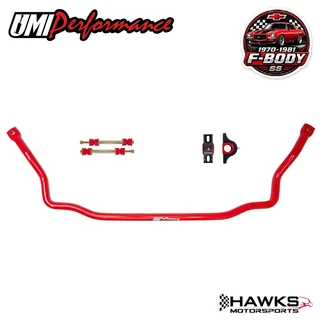
Hawks Motorsports is proud to offer our clients this : 1970-1981 Chevrolet Camaro, Pontiac Firebird, Formula, and Trans Am 1-1/4-Inch Solid Front Sway Bar from UMI Performance.
UMI Performance 4035 is a heavy-duty front sway bar engineered to reduce body roll, improve steering response, and help keep the front tires planted during cornering without sacrificing street-driving comfort.
The fixed-rate bar measures 1-1/4 inches, or 32mm, in diameter and is manufactured from solid 4140 chromoly steel. Each bar is CNC-bent for consistent geometry and an accurate fit at the factory front sway-bar mounting locations. UMI publishes a 530 lb/in deflection rating, making this an excellent multipurpose sway bar for street performance, autocross, pro-touring, road-course, and corner-carving applications.
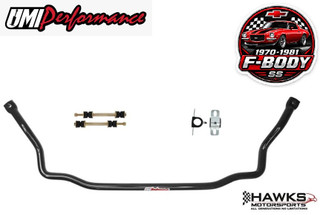
The complete standard kit includes one solid front sway bar, two polyurethane end-link assemblies, and two greaseable polyurethane frame bushings with clamshell-style clamps. The bar is available with a durable bright-red powder-coated finish.
UMI 4035 installs using the vehicle’s existing factory-style sway-bar locations. When properly installed and centered, the larger-diameter solid bar provides flatter cornering and more controlled front suspension movement than a typical smaller factory sway bar.
In addition to 1970-1981 second-generation Camaro and Firebird applications, UMI catalogs part #4035 for applicable 1964-1977 GM A-body vehicles.
4. KEY FEATURES
- Heavy-duty solid front sway bar
- 1-1/4-inch, or 32mm, outside diameter
- Fixed, non-adjustable design
- Manufacturer-published 530 lb/in deflection rating
- Helps reduce front-end body roll
- Improves cornering response and stability
- Helps keep the front tires planted during directional changes
- Designed to maintain street-friendly ride comfort
- Suitable for street, autocross, pro-touring, and road-course applications
- Solid 4140 chromoly-steel construction
- CNC-bent for consistent geometry and accurate fit
- One-piece construction
- Direct replacement for the factory-style front sway bar
- Uses existing factory frame and control-arm mounting locations
- Includes two polyurethane end-link assemblies
- Includes two greaseable polyurethane frame bushings
- Includes two clamshell-style frame-bushing clamps
- Compatible with standard-height and many lowered applications
- Compatible with standard and many tall-spindle or tall-ball-joint combinations
- Available in bright-BLACK powder coat
- Durable corrosion-resistant finish
- Designed, manufactured, tested, and raced in the USA
- UMI Performance base part #4035
- Red-finish part #4035-R
- Black-finish part #4035-B
5. MODEL INTERCHANGE AND FITMENT
Chevrolet Camaro
- 1970 Chevrolet Camaro — all applicable models
- 1971 Chevrolet Camaro — all applicable models
- 1972 Chevrolet Camaro — all applicable models
- 1973 Chevrolet Camaro — all applicable models
- 1974 Chevrolet Camaro — all applicable models
- 1975 Chevrolet Camaro — all applicable models
- 1976 Chevrolet Camaro — all applicable models
- 1977 Chevrolet Camaro — all applicable models
- 1978 Chevrolet Camaro — all applicable models
- 1979 Chevrolet Camaro — all applicable models
- 1980 Chevrolet Camaro — all applicable models
- 1981 Chevrolet Camaro — all applicable models
Includes Base/Sport Coupe, Rally Sport, SS, LT, Berlinetta, and Z28 applications where those models or packages were offered.
Pontiac Firebird, Esprit, Formula and Trans Am
- 1970 Pontiac Firebird — Base, Esprit, Formula, and Trans Am
- 1971 Pontiac Firebird — Base, Esprit, Formula, and Trans Am
- 1972 Pontiac Firebird — Base, Esprit, Formula, and Trans Am
- 1973 Pontiac Firebird — Base, Esprit, Formula, and Trans Am
- 1974 Pontiac Firebird — Base, Esprit, Formula, and Trans Am
- 1975 Pontiac Firebird — Base, Esprit, Formula, and Trans Am
- 1976 Pontiac Firebird — Base, Esprit, Formula, and Trans Am
- 1977 Pontiac Firebird — Base, Esprit, Formula, and Trans Am
- 1978 Pontiac Firebird — Base, Esprit, Formula, and Trans Am
- 1979 Pontiac Firebird — Base, Esprit, Formula, and Trans Am
- 1980 Pontiac Firebird — Base, Esprit, Formula, and Trans Am
- 1981 Pontiac Firebird — Base, Esprit, Formula, and Trans Am
Additional GM A-Body Interchange
UMI also catalogs part #4035 for applicable 1964-1977 GM A-body vehicles, including the following model families:
Buick
- Buick Special
- Buick Skylark
- Buick Gran Sport
- Buick GS, GS 350, GS 400, and GS 455
- Buick Sportwagon
- Buick Century
- Buick Regal
Chevrolet
- Chevrolet Chevelle
- Chevrolet Malibu
- Chevrolet El Camino
- Chevrolet Monte Carlo
- Chevrolet Laguna
Oldsmobile
- Oldsmobile F-85
- Oldsmobile Cutlass
- Oldsmobile 442
- Oldsmobile Vista Cruiser
Pontiac
- Pontiac Tempest
- Pontiac LeMans
- Pontiac GTO
- Pontiac Grand Prix
- Pontiac Grand Am
GMC
- 1971-1972 GMC Sprint
Important Fitment Notes
- Designed for vehicles retaining factory-style front sway-bar frame locations and control-arm end-link locations.
- UMI catalogs the bar for all 1970-1981 Chevrolet Camaro and Pontiac Firebird models.
- This is a fixed-rate, non-adjustable sway bar.
- The included end links are intended to work with most reasonable factory, raised, and lowered ride heights.
- The included end links are compatible with many standard-height and tall-spindle or tall-ball-joint combinations.
- Excessively raised or lowered vehicles may require different-length end links.
- UMI states that the supplied end-link spacer sleeves can be shortened by up to 3/4 inch when shorter end links are required.
- End-link position and angle must be evaluated with the vehicle resting at normal ride height.
- The end links do not need to be perfectly vertical for the sway bar to function properly.
- Engine swaps, aftermarket control arms, frame damage, unusual alignment settings, or heavily modified suspension geometry may affect clearance.
- The sway bar must be installed in the correct orientation. Installing it upside down can create tie-rod clearance problems.
- Check clearance around the idler arm, tie rods, brake lines, control arms, oil pan, and surrounding components before operating the vehicle.
- UMI part #3068 is available separately for applicable F-body installations requiring additional sway-bar-to-steering clearance.
- UMI part #4068 is available separately for A-body installations requiring additional clearance around an oversized idler-arm pivot.
- Optional UMI billet-aluminum 1-1/4-inch sway-bar brackets, part #0047, are available separately.
6. INSTALLATION NOTES
- Installation uses the vehicle’s existing factory-style sway-bar locations.
- Safely raise the front of the vehicle and support it by the frame before beginning installation.
- Remove the original end links, frame-bushing clamps, bushings, and front sway bar.
- Position the UMI bar in the correct orientation before attaching the end links.
- An upside-down bar will angle upward at the ends and may interfere with the tie rods.
- Attach both supplied end-link assemblies finger-tight before fully securing the frame-bushing clamps.
- Center the sway bar from side to side before final tightening.
- Lower the vehicle onto the tires or suitable supporting blocks before tightening the end links.
- Final end-link tightening must be completed at normal ride height to prevent polyurethane-bushing bind.
- End-link washers must cup toward the polyurethane bushings.
- Do not grease the polyurethane end-link bushings.
- Tighten the end links only until the bushings begin to bulge slightly.
- Do not overtighten the end-link bushings.
- If the supplied end links are too long, UMI permits shortening the center sleeves by up to 3/4 inch.
- Excessively raised or lowered vehicles may require separately purchased shorter or longer end links.
- Turn the steering completely from side to side and inspect all tie-rod, idler-arm, brake-line, control-arm, and sway-bar clearances.
- Verify that the bar moves freely without contacting nearby steering or suspension components.
- UMI recommends having a second person assist with positioning the solid sway bar during installation.
- A professional suspension alignment is recommended whenever the idler arm, steering linkage, or alignment settings are disturbed.